
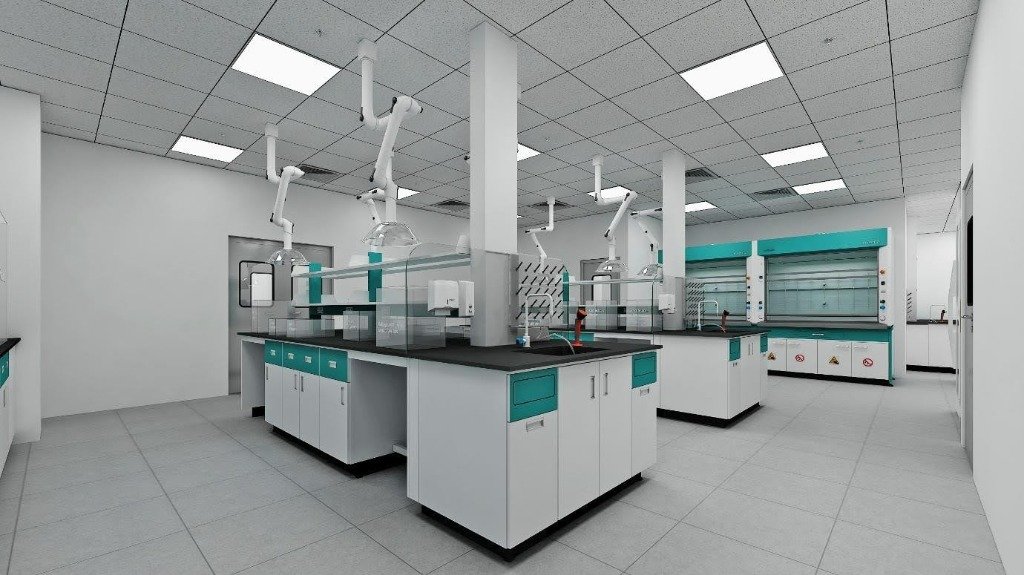
Comprehensive multidisciplinary engineering advisory across nine integrated domains, delivering precision, safety, energy efficiency, and regulatory compliance.
01
Spatial Planning & Programming
Laboratory Planning & Design Consultancy
Effective laboratory design begins with a meticulous understanding of scientific processes, personnel workflows, hazardous material storage, equipment logistics, and biosafety protocols. We work collaboratively with laboratory owners, principal researchers, and project architects to translate complex programmatic requirements into efficient, flexible, and fully compliant physical layouts.
Workflow Analysis & Spatial Programming: Segregation of clean and contaminated zones, sample flow optimization, and personnel movement mapping.
Biosafety & Containment Zoning: Detailed space layout in strict compliance with BSL-1 through BSL-3 criteria, anterooms, and barrier separation.
Casework & Furniture Systems Selection: Engineering specifications for heavy-duty metal, stainless steel, and polypropylene modular casework following SEFA 8 and EN 13150.
Future Adaptability & Modularity: Overhead service distribution carrier design, flexible plug-and-play benching systems, and demountable partitions.
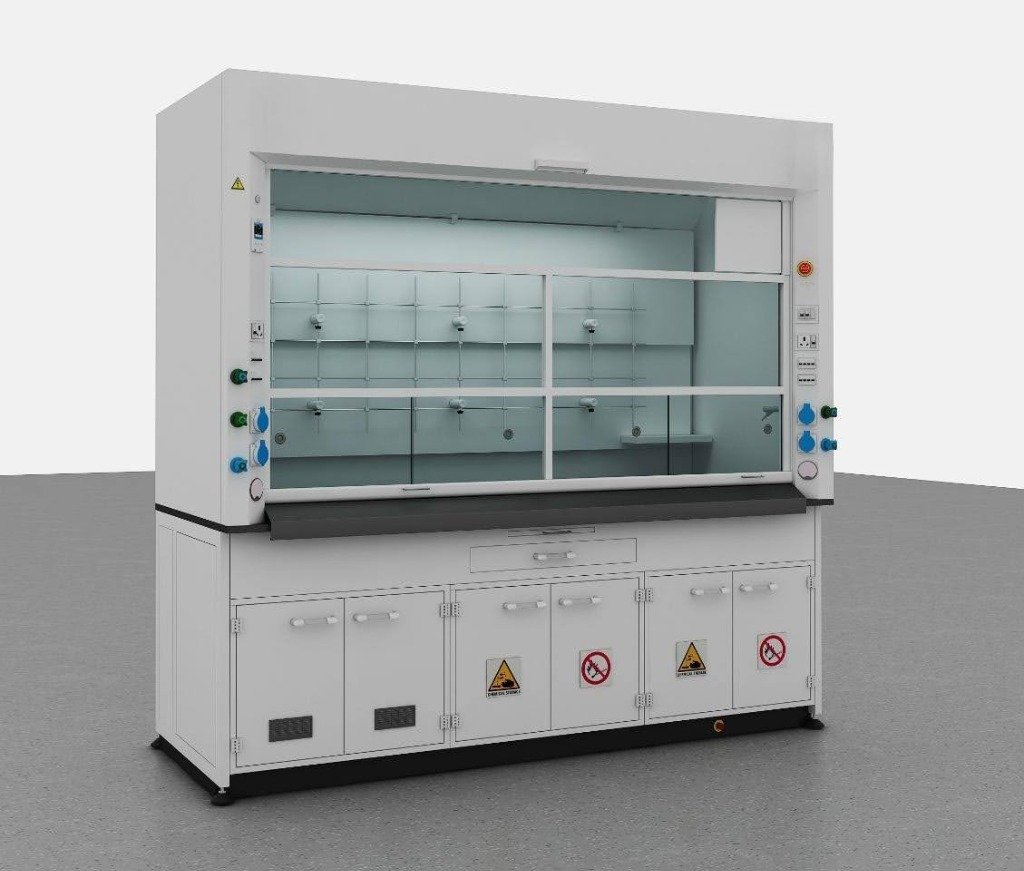
Laboratory fume hoods are essential engineering safety systems designed to protect laboratory personnel from exposure to hazardous chemical vapours, gases, fumes and airborne contaminants generated during laboratory operations. Our solutions combine airflow engineering, effective containment technology, ergonomic design and durable construction to create safer and more efficient laboratory environments.
From conventional chemical fume hoods to advanced variable air volume (VAV) systems, we develop solutions around application-specific safety, performance and operational efficiency.
Engineered Containment: Aerodynamic sashes, calibrated baffle geometry, digital airflow monitors, and continuous face velocity containment.
Fume Hood Configurations Covered
Conventional Laboratory Fume Hoods
General-purpose chemical fume hoods for routine chemical handling, sample preparation, and standard experimental protocols.
Walk-In Fume Hoods (Floor Mounted)
Designed for larger equipment, pilot-scale apparatus, roll-in carts, and experiments requiring expanded vertical working space.
Variable Air Volume (VAV) Systems
Dynamically regulates exhaust airflow based on real-time sash position, optimizing conditioning energy while maintaining strict face velocity containment.
Ductless Filtration Fume Hoods
Filter-based solutions for compatible applications where external exhaust ducting may not be practical, subject to rigorous chemical compatibility analysis.
Corrosive-Resistant Fume Hoods
Specialized construction utilizing solid polypropylene, PVDF, or unplasticized PVC interiors for aggressive mineral acids and digestions.
Special Application Fume Hoods
Application-specific containment solutions for high-temperature perchloric acid digestion with washdown systems, radioisotopes, or cleanroom environments.
Advanced Engineering Features & Design Checklist
Aerodynamic Sash Design: Optimized sash geometry and airfoil sill profiles to support smooth, eddy-free airflow entry at all working heights.
Optimized Baffle System: Strategically calibrated multi-slot baffles ensuring uniform exhaust distribution across dense apparatus layouts.
Airflow Monitoring & Alarms: Digital thermal or pitot-tube velocity sensors with visual LED status and audible alarms for abnormal airflow conditions.
Sash Management: Automatic sash position monitoring, sash-stop limiters, and auto-closing mechanisms to dramatically reduce unnecessary exhaust demand.
Chemical-Resistant Interiors: Solid phenolic resin, epoxy resin, ceramic, or seamless polypropylene liners selected according to chemical compatibility.
BMS Integration: Full protocol compatibility with building management systems via BACnet MS/TP, BACnet IP, or Modbus interfaces.
Laboratory safety is not an operational afterthought; it must be engineered directly into the architectural layout, ventilation balancing, utility distribution, and emergency infrastructure. We provide structured risk assessments and engineering reviews that safeguard researchers and facility assets against chemical, biological, and physical hazards.
Hazard Identification & Chemical Incompatibilities: Segregated storage planning for flammables, acids, oxidizers, and toxic gases in accordance with NFPA 45 and OSHA standards.
Emergency Drenching Equipment Planning: Strategic placement, hydraulic sizing, and tepid water loop coordination for emergency eyewash stations and safety showers complying with ANSI/ISEA Z358.1.
Differential Pressure & Directional Airflow: Calculation of cascades to ensure hazardous rooms remain continuously negative relative to clean corridors.
Compressed & Toxic Gas Safety: Gas detection sensor layout, automatic emergency shut-off valve integration, and gas cylinder bunker ventilation design.
Laboratories consume between 4 to 10 times more energy per square meter than typical commercial office buildings due to 100% outside air once-through ventilation, continuous fume hood exhaust, and intensive plug loads. Our sustainable engineering consultancy identifies targeted energy conservation measures (ECMs) that dramatically lower carbon footprint and operating expenditure without ever compromising containment safety.
Variable Air Volume (VAV) Optimization: Establishing dynamic sash setback strategies and occupancy-based air change rates (ACH) safely reducing exhaust volume.
Run-Around Coil Heat Recovery: Sizing glycol run-around loop energy recovery systems for hazardous laboratory exhaust streams, preventing cross-contamination while recovering up to 60% of sensible thermal energy.
Smart Labs Methodology: Alignment with the International Institute for Sustainable Laboratories (I2SL) and US DOE Smart Labs principles.
Green Building Certification Advisory: Credit documentation and modeling alignment for LEED v4/v4.1, BREEAM, and regional sustainability frameworks.
The mechanical, electrical, and plumbing infrastructure of a laboratory represents the largest share of facility complexity. We act as the technical coordinator bridging the specialist laboratory requirements and the core MEP engineering teams, ensuring clash-free spatial distribution and synchronized performance.
Laboratory Exhaust Ductwork Engineering: Specification of welded 316L stainless steel, FRP, or coated galvanized steel ductwork routing to minimize pressure drops and eliminate chemical accumulation pockets.
High-Plume Dilution Blowers: Induced-flow fan selection ensuring exhaust plume height safely disperses above building boundary layers and rooftop air intakes.
Clean & Process Utilities Coordination: Technical piping sizing for High Purity Gases, RO/DI deionized water, central laboratory vacuum, and compressed dry air (CDA).
Diffuser Placement & Draft Avoidance: Computational airflow analysis to ensure supply air diffusers do not create cross-drafts exceeding 30–50 FPM near fume hood sashes.
Building Management Systems & Intelligent Controls
Modern laboratories rely on dynamic airflow management systems to instantaneously compensate for fluctuating sash positions, door openings, and thermal loads. We design the control architectures, sensor specifications, and BMS sequence of operations that guarantee stability and real-time response.
High-Speed Venturi & VAV Actuators: Engineering control loops with rapid actuator response times (under 1 second) to maintain face velocity during sudden sash movement.
Room Air Balance Tracking: Volumetric offset and direct differential pressure tracking to prevent contaminated air migration into corridors.
Open-Protocol Network Integration: System interoperability ensuring seamless communication across BACnet IP/MSTP, Modbus, and enterprise SCADA platforms.
Critical Alarm Sequences: Fail-safe logic, redundant exhaust fan switchovers, emergency purge modes, and supervisory notification protocols.
Fire Protection & Environmental Engineering Consultancy
Laboratories pose unique fire risks and environmental discharge challenges that standard commercial fire and plumbing designs cannot handle. We develop specialized protection systems for hazardous chemical zones and design emissions treatment infrastructure that satisfies the most stringent municipal environmental authority mandates.
NFPA 45 Laboratory Fire Safety Compliance: Control zone fire barrier ratings, maximum allowable quantities (MAQs) of flammable liquids, and explosion relief criteria.
Special Hazard Fire Suppression: Clean agent gaseous suppression (Novec 1230, FM-200, Inergen) specification for sensitive analytical instrumentation suites and chemical solvent storage.
Wet Scrubbers & Air Emissions Abatement: Sizing packed-bed counterflow wet scrubbers and thermal oxidizers for corrosive, acidic, and toxic process exhausts.
Procuring specialized laboratory equipment, fume hoods, controls, and casework is fraught with vendor claims, proprietary lock-ins, and hidden operational costs. As independent consultants, we provide unbiased commercial and technical bid evaluation, protecting the client’s capital investment from substandard substitutions.
Vendor Bid Compliance Matrix: Line-by-line engineering audit of contractor and vendor submissions to verify compliance against project specifications.
Life-Cycle Cost (LCC) Analysis: Comparative evaluations weighing capital equipment cost against ongoing fan power, HVAC load, and filter replacement expenses.
Submittal & Shop Drawing Review: Rigorous review of manufacturer shop drawings, material test certificates, and equipment schedules prior to fabrication release.
A laboratory is only as safe as its verified performance under actual operational conditions. We provide rigorous, hands-on commissioning coordination and third-party verification that confirm every fume hood, room pressure cascade, and exhaust fan operates precisely according to design parameters prior to occupancy.
Factory Acceptance Testing (FAT): Witnessing physical inspections and initial aerodynamic containment tests at the manufacturer’s facility prior to shipping.
ASHRAE 110 & EN 14175 Containment Verification: Conducting face velocity profiling, visual smoke airflow characterization, and sulfur hexafluoride (SF6) tracer gas testing.
Integrated Testing & Air Balance (TAB) Oversight: Auditing room differential pressures, air change rates, and dynamic response during power loss or emergency sequences.
Final Handover Documentation & Training Audits: Compiling complete commissioning binders, O&M manuals, and auditing training programs for facility engineering personnel.